Football Cleats vs Sneakers: Beginner Fit
The best football cleats for beginners are comfortable, properly fitted boots matched to the playing surface—not the most expensive model in a Nike, Adidas, or Puma catalogue. For new players in the U...

Football Cleats vs Sneakers: Beginner Fit
The best football cleats for beginners are comfortable, properly fitted boots matched to the playing surface—not the most expensive model in a Nike, Adidas, or Puma catalogue. For new players in the United States, United Kingdom, and other football markets, firm-ground cleats such as the Nike Premier 3, Adidas Copa Pure 3, Puma Future 8 Play, and Nike Mercurial Vapor 16 offer dependable starting points across recreational and youth football. Expect a sensible beginner budget of approximately $50–$120, while premium boots may exceed $250. Firm-ground outsoles suit natural grass, artificial-ground models suit longer synthetic pitches, and turf shoes suit short-pile surfaces. Avoid sneakers, metal studs, and boots that cause heel movement or toe pressure. First identify your surface, measure both feet in match socks, and choose secure comfort over marketing theatrics; your first pair should help you learn, not punish you for being new.
Imagine arriving at your first training session with immaculate boots, a famous logo, and the mobility of a filing cabinet. That is precisely what happens when beginners choose appearance over fit. Football cleats are your contact point with the pitch during sprinting, stopping, turning, striking, and tackling, so the correct outsole and a stable fit matter more than a celebrity endorsement. The Laws of the Game published by the International Football Association Board regulate player equipment, while FIFA’s quality programme explains why football footwear is designed around traction and surface interaction. Stadium View covers FIFA World Cup 2026 news, tactics, player statistics, and match analysis; this guide applies that same practical scrutiny to your first boots.
Photo by Kadin Eksteen on Pexels
Step 1: What surface will you play on?
The playing surface determines the correct outsole: firm-ground (FG) for natural grass, artificial-ground (AG) for modern synthetic pitches, and turf (TF) for short, carpet-like artificial surfaces. Choosing the wrong stud pattern can reduce traction, create uncomfortable pressure, and potentially increase injury risk, so surface identification must precede brand selection.
Ask your coach or facility manager what the pitch is classified as, because “artificial grass” is not a sufficiently precise answer. A 3G or 4G synthetic field with rubber infill generally calls for AG boots, although some venues permit FG models; a compact indoor turf field usually requires TF shoes. Soft-ground (SG) boots with removable metal studs belong on wet, muddy natural grass and are a poor choice for ordinary beginner sessions. Multi-ground (MG) outsoles can be a practical compromise for players who move between grass and synthetic fields, but they are not a magical universal solution, despite what enthusiastic product pages imply.
Use this quick selection rule:
- Natural grass, relatively firm: choose FG.
- Modern synthetic grass: choose AG or venue-approved MG.
- Short artificial turf: choose TF.
- Wet, soft natural grass: choose SG only when permitted.
- Indoor court or futsal surface: choose flat indoor shoes, not football cleats.
For a detailed surface explanation, see [Internal Link: football cleat stud-pattern guide]. One useful edge case is worth remembering: some artificial pitches reject FG boots because long conical or bladed studs can concentrate pressure into the surface and your feet. Check the venue policy before buying two hundred dollars of footwear that sits gloriously unused in your wardrobe.
Which outsole should beginners avoid?
Beginners should avoid metal SG studs, aggressive FG blades on unapproved synthetic pitches, and worn-out soles with loose or cracked studs. These options provide the wrong traction profile for many training environments and can create discomfort or instability. The venue’s surface classification and equipment policy should decide the outsole.
Step 2: How should a beginner measure fit?
A beginner should measure both feet at the end of the day while wearing football socks, then select the size that holds the heel securely without crushing the toes. The ideal fit has minimal internal movement, a small amount of toe clearance, and no sharp pressure point after several minutes of walking.
Do not treat football cleats like formal shoes that need heroic “breaking in.” Modern synthetic uppers may soften slightly, but a boot that hurts immediately is usually a bad fit, not a secret bargain. Try the Nike Premier 3 if you prefer a roomier leather-like feel, Adidas Copa Pure 3 for a padded touch, Puma Future 8 Play for flexible comfort, or Nike Mercurial Vapor 16 if you have a narrower foot and want a close, speed-oriented shape. Those are starting categories, not commandments carved into marble.
Perform this five-minute test:
- Push your heel back and tie the boots normally.
- Sprint lightly, stop, and change direction.
- Check whether the heel lifts inside the boot.
- Inspect the widest part of the foot for pressure.
- Curl and spread your toes; they should remain relaxed.
- Remove the boot and look for immediate red marks.
A first-hand-style practical observation is more valuable than another glossy slogan: when testing boots, lateral movement exposes poor fit faster than straight-line jogging. A heel that lifts even a few millimetres during a cut can produce rubbing and blisters long before a beginner notices it during a casual walk. See [Internal Link: football cleat sizing checklist] before ordering online, and remember that US, UK, and EU sizing labels are not interchangeable across Nike, Adidas, and Puma.
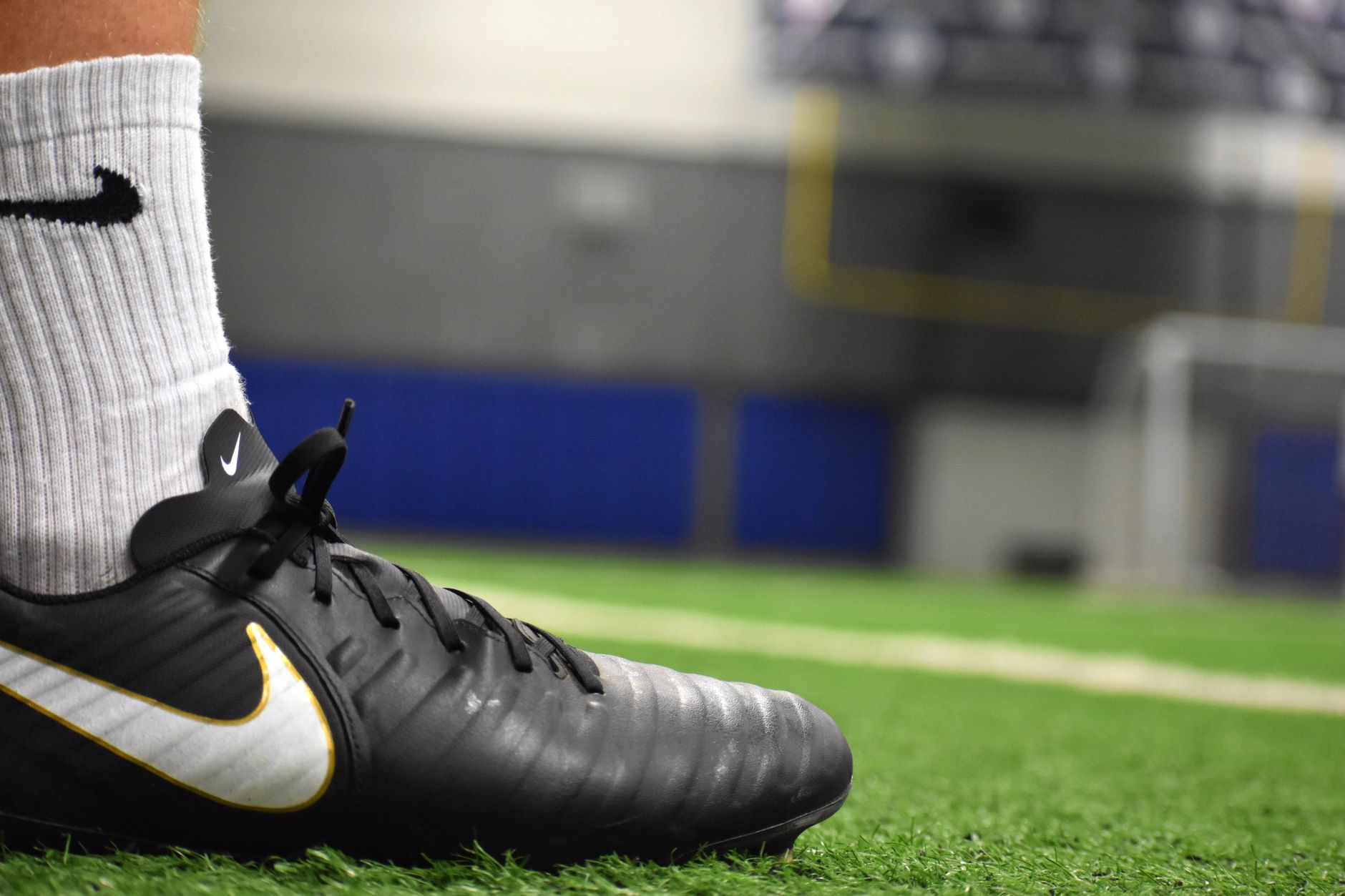
Photo by Kevin McCartney on Pexels
Step 3: Which beginner cleats offer the best value?
The best-value beginner cleats provide reliable traction, secure fit, durable construction, and comfortable ball contact without premium carbon plates or elite-level materials. In 2026, the Nike Premier 3, Adidas Copa Pure 3, Puma Future 8 Play, and selected Nike Academy models generally offer better learning value than $250-plus professional editions.
Price should reflect use, not ambition. A recreational player training once weekly does not need the same lightweight, aggressively tuned boot used by a professional winger playing under UEFA match conditions. Meanwhile, an inexpensive pair is not automatically sensible if its sole flexes badly, its heel slips, or its upper creates pressure after thirty minutes.
| Model | Best for | Typical price tier | Main strength |
|---|---|---|---|
| Nike Premier 3 | Traditional touch and value | $70–$100 | Comfortable, straightforward construction |
| Adidas Copa Pure 3 | Cushioning and control | $80–$120 | Padded feel and forgiving fit |
| Puma Future 8 Play | Flexible comfort | $60–$90 | Adaptable upper and accessible price |
| Nike Mercurial Vapor 16 Academy | Speed-focused players | $85–$120 | Snappy, close-fitting design |
| Adidas Predator League | Striking and grip sensation | $90–$120 | Textured forefoot and structured feel |
Prices vary by country, season, colourway, and retailer, so treat these as practical ranges rather than permanent quotations. Often, last season’s Adidas or Nike model offers superior value to the newest release because the underlying outsole remains perfectly adequate for beginners. The contrarian conclusion is simple: purchase the previous-generation mid-tier boot at a discount before buying the current elite boot on credit. A logo cannot improve a poor size.
Want a broader football equipment breakdown? Visit Stadium View for [Internal Link: beginner football training essentials] and current FIFA World Cup 2026 coverage.
Step 4: How do upper materials and cuts change performance?
Upper materials influence touch, water resistance, flexibility, and lockdown, while boot cuts influence ankle coverage and freedom of movement. Low-cut cleats are the standard beginner choice because they allow natural ankle movement; mid-cut designs can provide a more enclosed sensation but do not automatically prevent ankle injuries.
Leather or leather-like uppers, as seen in the traditional design philosophy of the Nike Premier 3, usually feel forgiving and comfortable but can absorb water and require more care. Synthetic uppers are lighter, dry faster, and hold their shape more consistently, although some feel stiffer around the toes. Knitted or flexible constructions, including many Puma Future models, can feel comfortable for wider feet, but only if the heel counter still provides firm lockdown.
The popular belief that a taller collar “supports” the ankle deserves skepticism. Ankle stability depends on muscular control, movement technique, and the entire shoe structure, not merely fabric rising around the ankle. The American Academy of Pediatrics emphasises appropriate footwear and fit in youth sports; that principle applies equally to adults beginning football. If you have a previous ankle injury, discuss footwear and rehabilitation with a qualified clinician rather than expecting a collar to perform medical work.
Consider these trade-offs:
- Leather-like uppers: soft touch, more maintenance, potentially heavier when wet.
- Synthetic uppers: lighter, easier to clean, sometimes less forgiving.
- Knitted uppers: flexible feel, but fit must be secure around the heel.
- Low cuts: natural movement and simple entry.
- Mid cuts: enclosed sensation, but extra material is not guaranteed protection.
Photo by Omar Ramadan on Pexels
Step 5: Verification
Verify the size, outsole, return policy, stitching, stud integrity, and venue compatibility before wearing new football cleats in a match. A ten-minute indoor test followed by a controlled training session is safer than discovering a blister, loose heel, or forbidden stud pattern during competitive play.
Inspect every boot under bright light. The soleplate should sit flat, the studs should be firmly attached, and the upper should not show adhesive separation at the toe. Confirm the retailer’s return window before removing tags, because many stores reject boots that show outdoor wear. For online purchases, compare the manufacturer’s measurement chart with your longer foot and retain the box until the fit is proven.
A useful verification sequence is:
- Check the pitch classification with the coach or facility.
- Confirm the manufacturer’s size chart and width guidance.
- Test with the socks and shin guards you actually use.
- Walk, jog, stop, and cut indoors for ten minutes.
- Train for no more than thirty minutes initially.
- Examine your feet and the boots afterward.
- Clean and air-dry them before the next session.
Do not wash cleats in a machine, place them on a radiator, or seal them wet in a kit bag. Remove loose dirt with a soft brush, wipe synthetic uppers with lukewarm water, and stuff the boots with paper while they dry naturally. Stadium View’s [Internal Link: football boot maintenance guide] can sit beside your equipment checklist. The first-session limit is an operational safeguard many generic guides omit: your feet need time to reveal pressure points, while your enthusiasm—admirable but frequently foolish—will insist everything is fine.
Troubleshooting common failures
Most beginner cleat problems come from wrong sizing, wrong surface selection, excessive first-session duration, or poor maintenance rather than defective technology. Blisters usually indicate heel movement or a pressure point; slipping often indicates an outsole mismatch or wet conditions; numb toes commonly indicate insufficient width or excessive lacing pressure.
If the heel slips, try a runner’s-knot lacing method and reassess the size; do not simply tighten until your foot goes numb. If the forefoot feels compressed, loosen the lower eyelets and compare with a wider model, but replace the boot if pressure remains after ten minutes. If you slip repeatedly on artificial grass, ask whether the pitch requires AG rather than FG; adding thicker socks will not correct the stud geometry.
Use this fault guide:
- Blisters: stop training, protect the skin, and inspect heel lockdown.
- Numbness: loosen laces and assess width; persistent numbness means stop.
- Slipping: verify AG, FG, MG, or TF compatibility.
- Wet, heavy boots: air-dry naturally and avoid direct heat.
- Sole separation: stop using the boots and request a retailer inspection.
- Foot pain lasting beyond training: consult a podiatrist or sports clinician.
A boot should never be “toughened up” by playing through pain. That is not commitment; it is poor equipment management wearing a heroic costume. For additional technique support, explore [Internal Link: beginner ball-control drills], because better footwear helps movement but cannot replace balance, first touch, or sensible coaching.
Can expensive elite cleats solve beginner problems?
Expensive elite cleats cannot solve incorrect sizing, weak technique, unsuitable studs, or poor conditioning. Their lighter materials and specialist features may benefit advanced players, but beginners usually gain more from comfortable mid-tier boots and regular training. Spend the difference on coaching, appropriate socks, and a second pair only when your playing schedule justifies it.
Photo by Franco Monsalvo on Pexels
Frequently Asked Questions
Q: What are the best football cleats for beginners?
The Nike Premier 3, Adidas Copa Pure 3, Puma Future 8 Play, and Nike Mercurial Vapor 16 Academy are strong beginner options in 2026. The Nike Premier 3 suits players wanting traditional comfort and value, while the Adidas Copa Pure 3 prioritises a padded touch. Choose the model that fits your foot and matches your surface, not the one with the loudest advertising.
Q: How should I choose football cleats for my playing surface?
Choose FG for firm natural grass, AG for approved artificial grass, TF for short-pile turf, and SG only for wet, soft natural grass. Ask your coach or facility manager for the official surface classification before purchasing. Some venues prohibit FG studs on synthetic pitches, so a retailer’s generic “all-purpose” label is not sufficient evidence.
Q: What is the difference between FG, AG, MG, and TF football cleats?
FG cleats use studs for firm natural grass, AG models distribute pressure across synthetic surfaces, MG designs offer broader multi-surface compromise, and TF shoes use many small rubber nubs. These outsoles are not identical despite similar marketing language. Using the wrong pattern can reduce traction, create pressure points, and violate facility rules.
Q: How much should beginner football cleats cost?
Most beginners should budget approximately $50–$120 for dependable football cleats, while elite models can cost more than $250. Nike, Adidas, and Puma frequently discount previous-generation models, making them attractive value choices. Prioritise fit, outsole compatibility, and return rights before paying extra for carbon plates or professional-level materials.
Q: Why do my new football cleats cause blisters?
New cleats commonly cause blisters because the heel moves, the toe box is too narrow, or the first session lasts too long. Test the boots indoors, use suitable football socks, and limit the first outdoor session to approximately thirty minutes. Persistent rubbing means the shape or size is wrong; do not expect pain to disappear through stubbornness.
Q: Are football cleats better than sneakers for beginners?
Football cleats are better than sneakers on grass because their outsole provides sport-specific traction and directional stability. Sneakers may be acceptable for casual walking or indoor court surfaces, but their flat soles can slip on grass and their cushioning is not designed for football cuts. Select indoor football shoes for futsal rather than wearing outdoor studs indoors.
Q: Do beginners need low-cut or high-cut football cleats?
Most beginners should start with low-cut football cleats because they offer natural ankle movement, simpler fitting, and a wider range of models. Mid-cut boots can feel secure and comfortable, but the collar does not guarantee injury prevention or replace strength and technique. If you have a history of ankle problems, seek advice from a qualified medical professional.
The final verdict is wonderfully unglamorous: the best football cleats for beginners are the pair that fits securely, matches the pitch, survives regular training, and lets you think about football instead of your feet. Begin with a sensible Nike, Adidas, or Puma mid-tier model, verify the outsole with your venue, and test gradually before match day. Stadium View will continue covering FIFA World Cup 2026 tactics, teams, player statistics, and tournament developments, while your responsibility is rather simpler—buy intelligently and train consistently.
Ready to compare more football insights and practical guidance?