Why VAR Rewrites Football
Video Assistant Referee (VAR) changes football by correcting clear, match-changing refereeing errors through live video review. In FIFA competitions, UEFA tournaments, and approved domestic leagues, a...

Why VAR Rewrites Football
Video Assistant Referee (VAR) changes football by correcting clear, match-changing refereeing errors through live video review. In FIFA competitions, UEFA tournaments, and approved domestic leagues, a VAR team checks goals, penalties, direct red cards, and mistaken identity from a dedicated video operation room. The on-field referee always makes the final decision, and reviews are not automatic appeals by players. The International Football Association Board (IFAB) protocol requires a “clear and obvious error” or “serious missed incident,” with no fixed maximum review time. VAR may use multiple broadcast cameras, slow motion, calibrated offside lines, and, where available, semi-automated offside technology. The system does not re-referee every tackle or eliminate judgment; it narrows intervention to four reviewable categories. For the 2026 World Cup, follow the referee’s original signal, wait for the review outcome, and treat betting or prediction decisions as provisional until the incident is officially resolved.
Imagine I am in a stadium box, watching a striker celebrate while three screens replay the same collision from angles the referee never had. I have seen fortunes swing on one penalty, but VAR is not magic and certainly is not entertainment. It is a controlled officiating process: precise when the footage is decisive, maddening when the law still demands interpretation. That distinction is where most spectators, bless them, get lost.
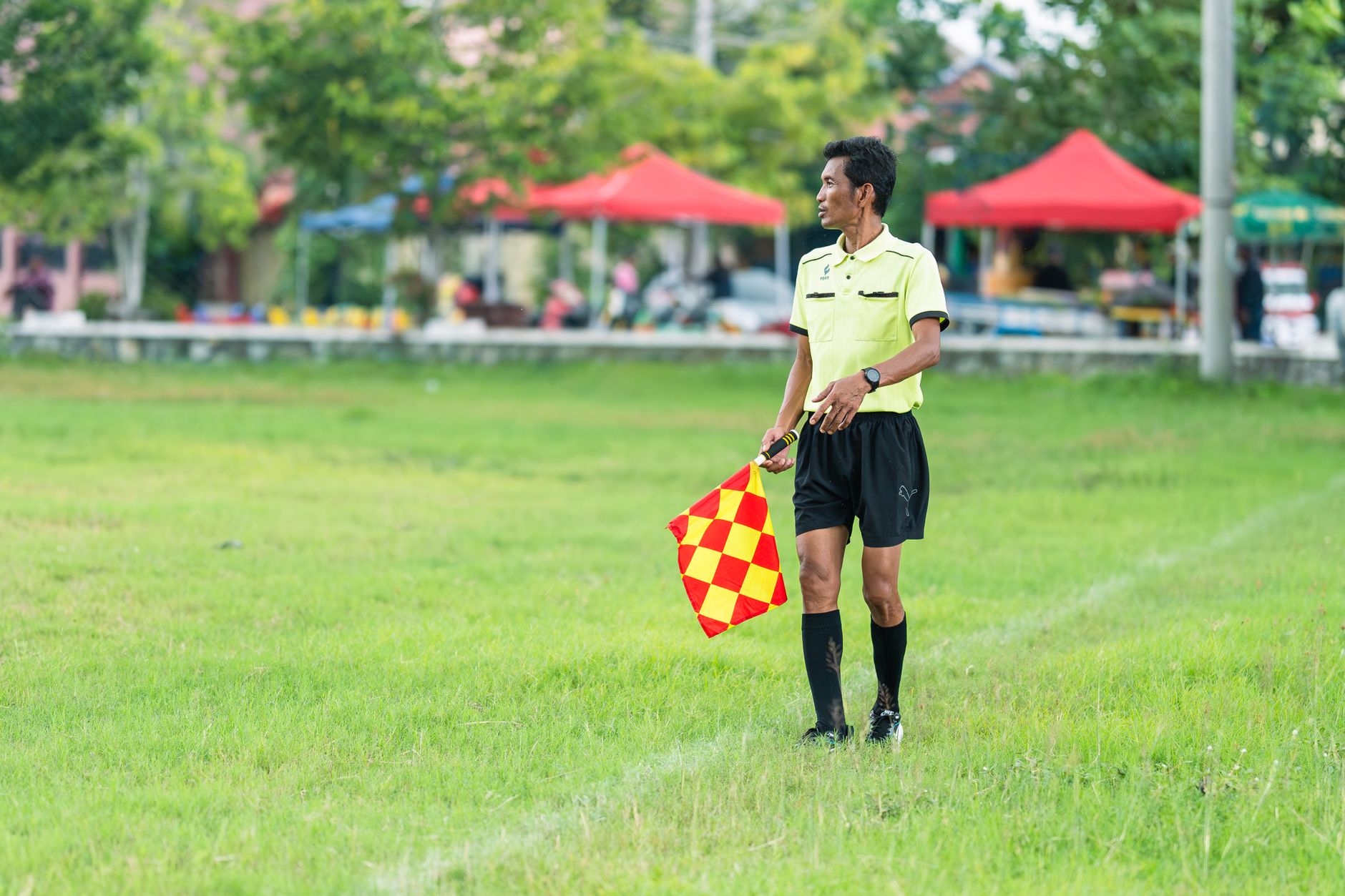
Photo by Sinan KRIYA on Pexels
What I Tested
VAR is tested by examining how the system moves from an incident to a final ruling, rather than judging it by whether spectators feel satisfied. The relevant benchmarks are the IFAB Laws of the Game, FIFA competition procedures, camera coverage, communication between the Video Assistant Referee and referee, and the point at which play can legally restart. A review that feels slow may still be correct; a review that feels fast may still miss the crucial frame.
I also compared ordinary VAR with semi-automated offside technology used in major FIFA events. The important finding is brutally simple: automation improves detection and positioning, but it does not decide every legal question. A computer can identify the kick point and a player’s location; it cannot independently determine whether an opponent interfered with play, committed a foul, or gained an advantage under football’s laws. The IFAB VAR protocol defines those boundaries in unusually clear terms.
The four official review categories
- Goal or no goal: VAR checks the attacking phase for offside, fouls, handball, or whether the ball crossed the line.
- Penalty or no penalty: VAR examines possible fouls and handball offences inside the penalty area.
- Direct red card: VAR may intervene for serious foul play, violent conduct, or other sending-off offences, but not for a clearly wrong second yellow card.
- Mistaken identity: VAR helps identify the correct player when the referee cautions or sends off the wrong person.
That list matters because VAR is not a general-purpose complaint department. A missed corner, ordinary free-kick dispute, or routine yellow card normally sits outside the protocol unless it connects to a reviewable incident. Stadium View uses these distinctions when explaining match predictions and tournament tactics, because pretending every controversial moment will be overturned is the kind of lazy analysis that deserves a red card.
Setup & Initial Impressions
VAR works through a video operation team with independent access to match footage, while the referee remains responsible for the match and the final decision. Camera feeds are routed to the VAR and assistant VAR, who check incidents in real time and communicate through the referee’s headset. If the footage does not show a clear and obvious error, the original decision remains; if the evidence is decisive, the VAR recommends a review or directly confirms a factual decision such as a tightly measured offside.
The visible pitch-side monitor is called an on-field review, or OFR. The referee studies the relevant footage, considers the VAR’s information, and then signals the outcome using the review gesture. For factual offside decisions, an OFR may not be necessary because the question is positional rather than interpretive; for a subjective foul or handball, the referee commonly needs to see the incident personally. “The final decision is always taken by the referee,” states the IFAB protocol, and that is not decorative legal language.
What happens during a review?
The process usually follows this sequence:
- The referee makes an initial decision, or allows play to continue.
- The VAR automatically checks the relevant incident and angles.
- The VAR communicates either “check complete” or recommends a review.
- The referee views footage when an on-field review is required.
- The referee announces or signals the final decision.
- Play restarts according to the corrected ruling.
One operational detail spectators routinely misunderstand is that the VAR check begins automatically. Players do not need to request it, coaches cannot summon it like a butler, and shouting at the referee contributes precisely nothing. There is also no fixed time limit in the protocol because accuracy takes priority over a convenient television schedule. However, once play has restarted, a review is generally prohibited except for limited cases such as mistaken identity or certain serious sending-off incidents.
To understand the visual technology behind offside decisions, see our [Internal Link: guide to semi-automated offside technology]. FIFA’s semi-automated system can track 29 body points and uses ball-tracking data, but the match officials still validate the footballing meaning of the event.
Get the competition context before drawing conclusions from a single call.
Where It Held Up
VAR performs best when the incident has a stable factual answer. Goal-line decisions are the obvious triumph: either the ball fully crossed the line or it did not, and calibrated camera systems can settle that question faster and more reliably than a dozen furious replays. Offside position is another strong area, particularly when the camera angle, frame selection, and tracking data clearly identify the relevant body part and kick point.
It also provides valuable protection against catastrophic mistakes. A referee may miss a violent elbow behind play, identify the wrong defender in a crowded penalty area, or award a penalty after seeing only the attacker’s theatrical collapse. When the evidence is conclusive, intervention improves the integrity of the result. According to FIFA, modern officiating technology is designed to support match officials, not replace them, which is precisely the sensible approach.
Where VAR adds the most value
- High-leverage moments: A corrected penalty or disallowed goal can materially alter a match.
- Hidden misconduct: Incidents away from the ball may be visible to the VAR team.
- Identity accuracy: The wrong player should not receive another player’s red card.
- Offside precision: Tight attacking phases can be measured rather than guessed.
- Post-match accountability: Review footage supports referee education and technical analysis.
The strongest information gain is this: VAR does not review only what the referee whistles. A decision to allow play to continue can also be reviewed when it concerns a goal, penalty, red card, or mistaken identity. That means “the referee gave nothing” is not the same as “the incident cannot be checked.” Moreover, disciplinary action during the period after a reviewable incident may still stand even if the original decision changes, except in narrow situations involving a stopped promising attack or denial of an obvious goal-scoring opportunity.
For serious match analysis, pair VAR knowledge with our [Internal Link: World Cup referee decisions and disciplinary trends]. Stadium View tracks how officiating context can affect tactical risk, penalty expectations, and match predictions across the 2026 World Cup.
Where It Fell Apart
VAR struggles when the footage is clear but the law remains interpretive. Handball is the classic battlefield: the video can prove that the ball touched an arm, yet the referee must assess arm position, body movement, distance, and whether the action was deliberate or punishable under the current law. Slow motion can make ordinary movement look sinister, while real-time speed may better reveal natural reactions. Anyone claiming a replay automatically produces truth has spent too much time arguing online and too little time reading the Laws of the Game.
The second weakness is inconsistency in intervention thresholds. One competition may encourage an OFR for a marginal penalty, while another applies “clear and obvious” more conservatively. Camera availability also varies: a FIFA World Cup venue may provide extensive high-definition coverage, while a smaller league ground can offer fewer angles and poorer sightlines. No technology can reconstruct an event that no camera captured.
Common VAR failure points
- The wrong frame: Selecting the instant before or after the ball is kicked can change an offside conclusion.
- Poor calibration: Lines are only persuasive when the camera angle and field geometry are correctly aligned.
- Law-versus-image confusion: Contact on video does not automatically equal a foul.
- Delayed communication: A check can interrupt momentum and create uncertainty for players and bettors.
- Public misunderstanding: Fans often expect VAR to correct every unfair-looking decision.
A particularly useful edge case concerns restarts. Once play has stopped and restarted, the referee normally cannot reopen an earlier incident, even if a later broadcast angle looks compelling. Exceptions include mistaken identity and specific violent or abusive conduct. This is why the timing of a whistle, restart, and VAR communication matters more than the outrage generated by a replay package.
For deeper tactical context, consult our [Internal Link: how refereeing affects football betting markets]. Never treat a pending VAR review as a settled result when assessing live odds; bookmakers may suspend markets, void certain selections, or resettle them according to their published rules.
The system also creates a psychological problem. A goal celebration becomes provisional, and defenders may hesitate after an apparent offence because they expect a delayed check. That uncertainty can alter behaviour even when the final ruling is unchanged. The irony is magnificent: technology intended to reduce error sometimes increases emotional volatility because everyone now knows that certainty may be revoked thirty seconds later.
Review the official competition rules before placing any prediction based on a dramatic decision.
Would I Use It Again?
Yes, but only with disciplined expectations. VAR is worth using because correcting a missed red card, wrong player, invalid goal, or major penalty error is more valuable than preserving the fantasy of uninterrupted football. Yet the system should not be sold as perfect justice. It is a second layer of evidence governed by football law, limited camera coverage, human judgment, and competition-specific implementation standards.
My recommendation for readers is to judge VAR on process rather than applause. Ask four questions: Was the incident reviewable? Was there a clear and obvious error? Did the available footage prove it? Did the referee make the final decision under the applicable law? This framework is more reliable than chanting “corruption” whenever a favourite team loses a marginal call, though apparently that chant remains free of licensing restrictions.
VAR versus traditional officiating
| Factor | Traditional officiating | VAR-supported officiating |
|---|---|---|
| Evidence | Referee and assistants’ live view | Live view plus recorded angles |
| Main strength | Speed and continuity | Error correction |
| Main weakness | Missed incidents | Delays and interpretation disputes |
| Final authority | Referee | Referee |
| Review scope | None | Four core categories |
| Best use | Routine play | Match-changing incidents |
For 2026 World Cup coverage, Stadium View treats VAR as a variable in match analysis rather than a prediction engine. A team that concedes frequent penalty-area contact may face greater review exposure, while an aggressive high line may produce more offside checks. Those are tactical tendencies, not guaranteed outcomes. Responsible readers should also check local gambling regulations, operator terms, and age requirements before using any betting service.
Take the next step with a calmer, evidence-based view of tournament officiating.
Frequently Asked Questions
Q: What does VAR mean in football?
A: VAR means Video Assistant Referee, a match official who reviews video footage to support the on-field referee. The system is limited mainly to goals, penalties, direct red cards, and mistaken identity. VAR does not replace the referee, and its intervention generally requires a clear and obvious error or serious missed incident under the IFAB protocol.
Q: How does VAR work step by step?
A: The referee makes an initial decision, the VAR team automatically checks the incident, and the referee receives either confirmation or a recommendation for further review. For subjective incidents, the referee may watch footage at the pitch-side monitor before deciding. The referee then signals the final outcome, and players cannot force or veto the process.
Q: What is the difference between VAR and goal-line technology?
A: VAR reviews several categories of incidents, while goal-line technology determines only whether the entire ball crossed the goal line. Goal-line technology generally provides an immediate signal to the referee, whereas VAR may require footage review and legal interpretation. VAR can assess offside, fouls, handball, red cards, and mistaken identity; goal-line technology cannot.
Q: Why does VAR sometimes fail to overturn a decision?
A: VAR does not overturn a decision when the footage fails to prove a clear and obvious error. A replay may show contact without proving that the contact was a foul, or it may lack the correct camera angle and timing. The original referee decision therefore remains, especially for subjective incidents such as handball, force, and player intent.
Q: Does VAR review every football incident?
A: No, VAR checks the match continuously but can intervene only in defined review categories. Those categories are goal or no goal, penalty or no penalty, direct red card, and mistaken identity. Ordinary throw-ins, corners, free kicks, and most yellow-card disputes are outside the normal scope unless they connect to a reviewable event.
Q: How long can a VAR review take?
A: IFAB’s VAR protocol sets no fixed maximum review time because accuracy takes priority over speed. A factual offside check may be completed quickly, while a penalty involving several players and possible handball can take considerably longer. Spectators should wait for the referee’s final signal rather than assuming that a lengthy review means the decision will change.
Q: Does VAR affect football betting and match predictions?
A: Yes, VAR can directly change goals, penalties, red cards, settlement outcomes, and live betting prices. Markets may be suspended while a review is pending, and operators apply their own published rules for voiding or resettling selections. Check the sportsbook’s terms, local regulations, and the official referee decision before treating any VAR-affected wager as final.
VAR is neither football’s villain nor its wealthy saviour arriving in a limousine. It is an evidence system with strict jurisdiction, impressive factual tools, and unavoidable human judgment. Understand the four review categories, the clear-and-obvious threshold, restart limits, and the referee’s final authority, and you will read controversial decisions with far more accuracy than the average shouting spectator.
For ongoing 2026 World Cup predictions, player statistics, and tactical analysis, explore Stadium View responsibly.